Find your way through data.
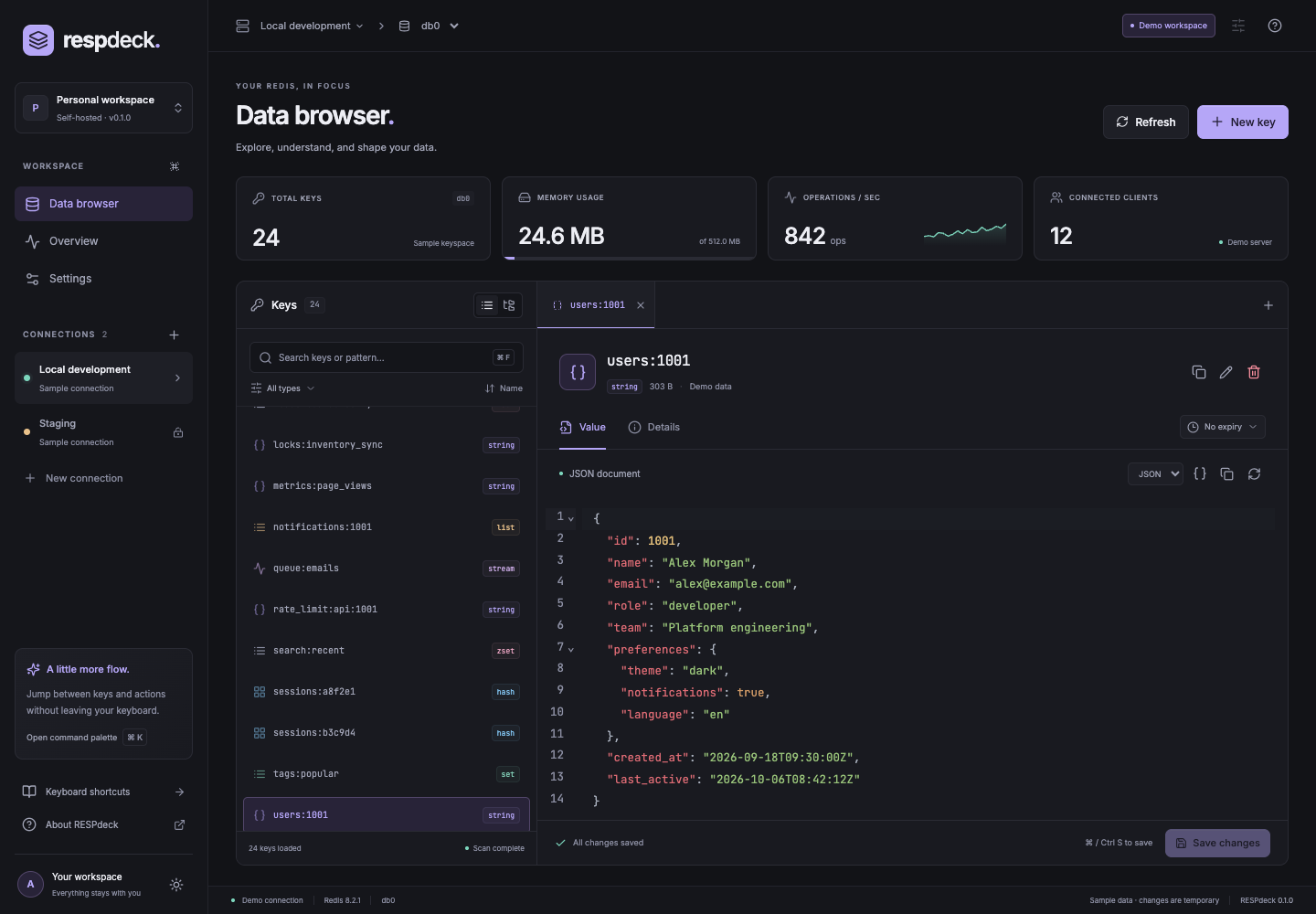
Cursor-based scanning, namespace groups, pattern filters, and virtualized lists. Browse incrementally as your keyspace grows.
users:*⌘ F
users:1001string
users:1002string
 RESPdeck
A thoughtful workspace for your data.
Explore, understand, and shape Redis in a calm,
modern interface.
No sign-up. Sample data. Make yourself at home.
LESS FRICTION. MORE CLARITY.
From a single key to a busy database, keep your workflow clear and your data close.
Cursor-based scanning, namespace groups, pattern filters, and virtualized lists. Browse incrementally as your keyspace grows.
users:*⌘ F
users:1001string
users:1002string
Inspect and edit strings, hashes, lists, sets, sorted sets, and streams. Format JSON and manage expiration in one place.
Run on your own server with Docker. Verified TLS, ACL credentials, and API-enforced read-only connections help you work with care.
MAKE IT FEEL LIKE HOME
Light, dark, or in sync with your system. Three considered accents. A quieter interface for the work that matters.
FROM REPO TO WORKSPACE
Start with the demo, then configure your administrator password to connect a real Redis server.
Read the setup guidegit clone https://github.com/aeke/respdeck.git
cd respdeck
docker compose up --build -dhttp://localhost:4310
A FEW THINGS TO KNOW
Yes. RESPdeck is released under the MIT license. Use it, inspect it, and contribute on GitHub.
No. The hosted demo uses synthetic data in your browser. Edits reset on reload. Run RESPdeck on your own infrastructure for real connections.
The initial release candidate supports standalone Redis and six core data types. Cluster, Sentinel, SSH tunnels, RedisJSON modules, and multi-user access are outside the current release.
RESPdeck includes no analytics or telemetry. The GitHub Pages demo is hosted by GitHub; real Redis connections stay on your self-hosted server.
Built in the open. Better with you.